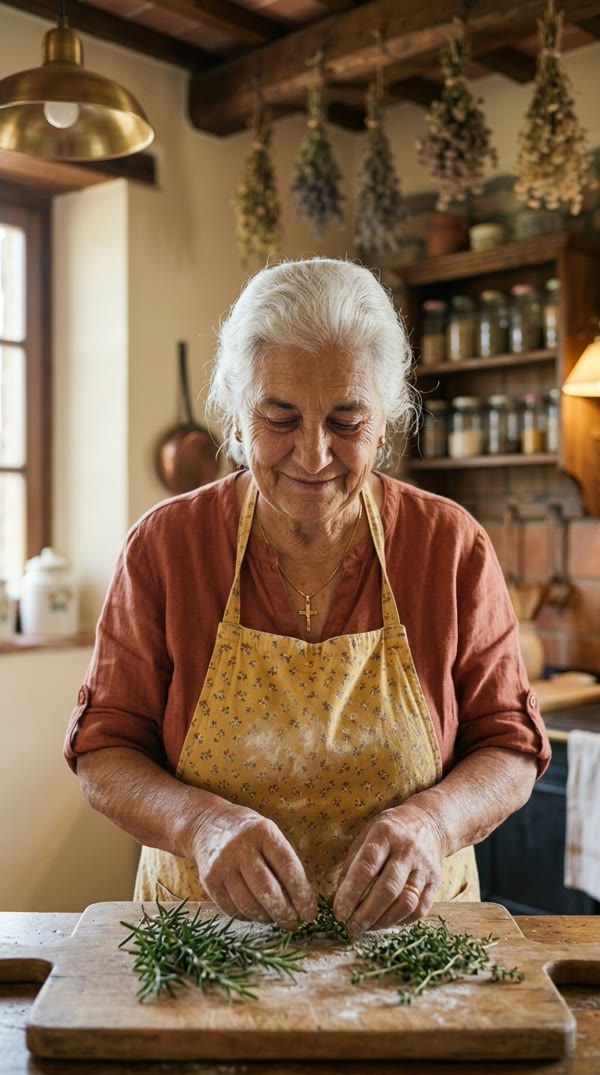
When Rosa was eight, her grandmother sat her on a wooden stool in the kitchen and showed her how to choose a tomato. Press it gently. If it pushes back, it's good. If it gives, it's tired. That was the first lesson.
By the time Rosa was twenty, her grandmother had passed away and her mother was teaching her grandchildren the same thing. By the time Rosa was fifty, she was teaching it to her own daughters. The lesson hadn't changed. The kitchen hadn't changed. The tomato hadn't changed.
Five generations of women in this family. Five rules they all kept. They aren't fancy. They aren't trendy. But every recipe in Rosa's book — every paste, every tea, every soup, every oil — sits on top of these five.
The medicine is in the kitchen, not the pharmacy.
Most of what aches in a modern body — restless nights, slow digestion, stiff joints, dull skin — was being handled by women in this family long before pharmacies existed. Not because they were clever, but because the food they cooked already contained what the body needed. Garlic, fennel, rosemary, lemon, olive oil. None of it costs more than a euro. All of it works.
If you understand why, you don't need a recipe.
Rosa's mother never followed measurements. She'd say "the right amount of salt" and your hand learned what that meant by watching hers. The recipes are training wheels. The real skill is understanding what each ingredient does — why fennel softens a tight gut, why warm oil reaches stiffer joints than cold cream — so that one day, when the cupboard's bare, you can substitute and the medicine still works.
Every recipe in the book carries the why. Take the why away and you're left with instructions. Keep it, and you're left with knowledge.
A few minutes a day, every day — not an hour, once a week.
The body responds to consistency, not heroics. A spoonful of warm honey-lemon at breakfast every day for a month will do more than three "wellness retreats" a year. Rosa's grandmother had a single phrase for this: poco e spesso. A little, often.
None of these recipes take longer than ten minutes. Most take three. The job is to build them into the small spaces of the day — the kettle on at 6am, the oil rubbed in before bed — until they become as automatic as brushing your teeth.
Touch the part that hurts. Don't just swallow something for it.
This was Rosa's most-used phrase when raising her own daughters. A pill goes through the bloodstream and hopes to find the joint. A hand on the joint, with warm oil, is already there. The mind notices the touch. The body responds to the warmth. The joint receives the medicine directly.
Modern wellness has gotten very good at remote interventions — apps, trackers, protocols. The Italian kitchen has stayed close. The food touches the gut. The oil touches the skin. The tea is held in the hand. Healing in this tradition is always physical.
Whatever you make, share it. Especially with whoever needs it most.
Every Sunday until she was 76, Rosa's grandmother walked a small jar of broth or oil to whichever neighbour was struggling that week. She did it for fifty-two Sundays a year for sixty years. She wasn't a saint. She just believed that food made for one person, if it sat in the cupboard alone, lost something.
This rule is the one Rosa is most insistent about. Make the recipes. Cook for yourself. But also cook for someone who needs it. The medicine is somehow stronger that way. We don't have to know why.
"Five generations of nonne can't be wrong about everything."
The book is one hundred and forty-eight recipes. But really, it's these five rules, applied a hundred different ways. Once you have them, you'll start applying them to whatever's in your own cupboard. That's the point. That's how the recipes have survived a hundred years.
con amore, Rosa ♡