One of Rosa's daughters is a pharmacist. She sees, every day, the same scene: a woman in her fifties, sometimes sixties, comes in with stiff hands. The doctor has given her a tube of pharmaceutical cream. She pays for it, takes it home, rubs it in. Two weeks later, she's back. The cream isn't working. They try a different one. Then a pill. Then physical therapy.
Meanwhile, in Rosa's kitchen, three streets away, the same woman's mother is rubbing her hands with warm olive oil and a sprig of rosemary. And her hands feel better in three days.
It sounds too simple. But here's the thing: most pharmaceutical anti-inflammatory creams aren't doing anything pharmacological at all. The active ingredient — usually 1% diclofenac or similar — is in such low concentration that the topical effect is minimal. What's actually working in those creams is the vehicle: the warm, oily base that carries it. The massage of rubbing it in. The 30 seconds of attention to the painful joint.
In other words: most of the relief is coming from the oil, not the drug. And Rosa's kitchen has better oil than the pharmacy.
The actual mechanism — three things.
When you rub warm oil into a stiff joint, three things happen at once:
One. The warmth itself dilates the small capillaries near the surface of your skin. More blood reaches the joint. Stiffness eases as the surrounding tissue softens. This is why heat packs work — and why a warm oil massage works longer, because the oil holds the heat.
Two. Olive oil, specifically, contains a compound called oleocanthal. It was identified by researchers at Monell Chemical Senses Center in 2005, who noticed that high-quality extra virgin olive oil produces a distinct throat-burn — the same sensation as ibuprofen syrup. They tested it. Oleocanthal is, biochemically, an NSAID. It inhibits the same COX-1 and COX-2 enzymes that ibuprofen does.
You can't get a therapeutic dose by eating olive oil. But applied topically, with massage, on a chronically inflamed joint, the data suggests there's a small but real anti-inflammatory effect.
Three. The rosemary. Rosemary essential oil contains 1,8-cineole and camphor, both of which are mildly counter-irritant. They give your skin a faint cooling-then-warming sensation that, neurologically, partially blocks the brain's perception of deeper pain. It's the same principle behind menthol creams — but rosemary smells like a kitchen, not a hospital.
What Rosa actually does.
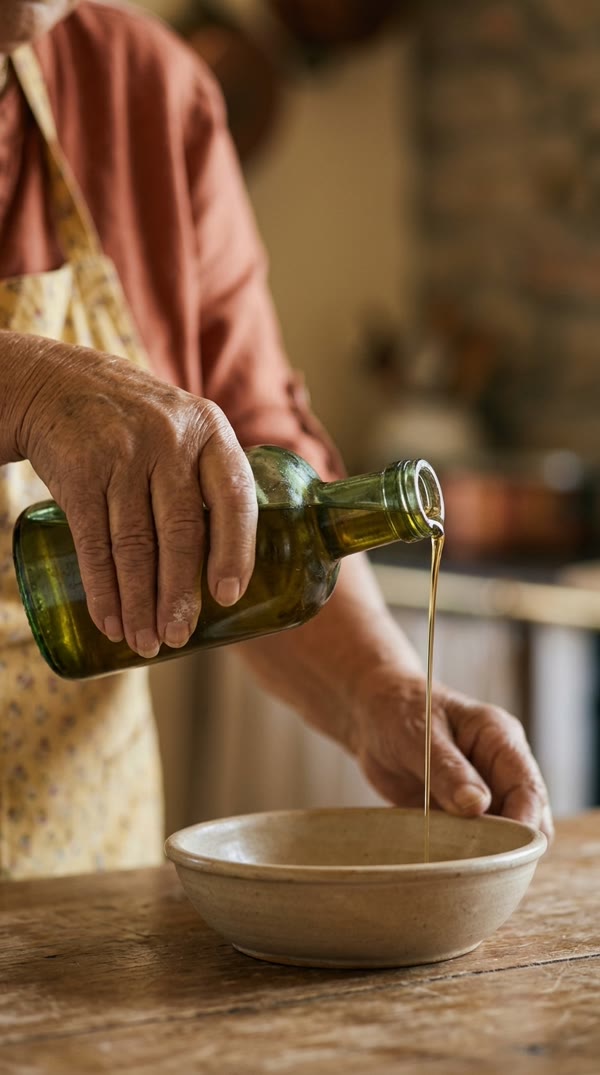
She doesn't measure. She has a small glass bottle by the stove, half-full of olive oil from her cousin's frantoio. Every few months she crushes a few sprigs of rosemary, drops them in, and lets the bottle sit for two weeks. The oil takes on a faint green tint and smells like the hill above her village.
When her hands are stiff (most mornings, in winter), she pours a small amount into her palm, holds it for a moment to warm it with body heat, and rubs it slowly into each knuckle. She does this for about a minute per hand. Then she lets the oil sit for ten minutes before washing.
That's it. There's no protocol. There's no measuring. There's no app to log it in.
Rosa's recipe
Rosemary joint oil
- 200ml good extra virgin olive oil (the more peppery the better — that's the oleocanthal)
- 3 sprigs fresh rosemary, lightly bruised with the back of a knife
- 1 small piece of dried orange peel (optional — it adds limonene, which improves skin absorption)
- Drop the rosemary and orange peel into a small glass bottle.
- Pour the olive oil over until the herbs are fully submerged.
- Cap loosely and leave somewhere dark and room-temperature for 14 days. Shake gently every few days.
- Strain through a fine sieve into a clean bottle. Keep beside the stove or in a kitchen cupboard. It lasts about 6 months.
To use: warm a small amount in your palm, massage gently into the stiff joint for 60 seconds. Leave for 10 minutes before washing. Twice a day for the first week, once a day after.
"Pills work on the inside, but the joint is on the outside. Of course you have to touch it."
Rosa is 78. She still types, peels potatoes, and writes by hand. She has never taken a prescription anti-inflammatory in her life.
She is, of course, an outlier. Some joint pain is structural and needs medical care — torn cartilage, autoimmune conditions, fractures. The oil won't fix those. But for the everyday stiffness that creeps in after 40, the kind your doctor calls "wear and tear" and shrugs at? Try the oil for two weeks. The worst that happens is your kitchen smells a little nicer.
con amore, Rosa ♡